


Foreign Outflows Push Indian Indices Toward 15-Year Low
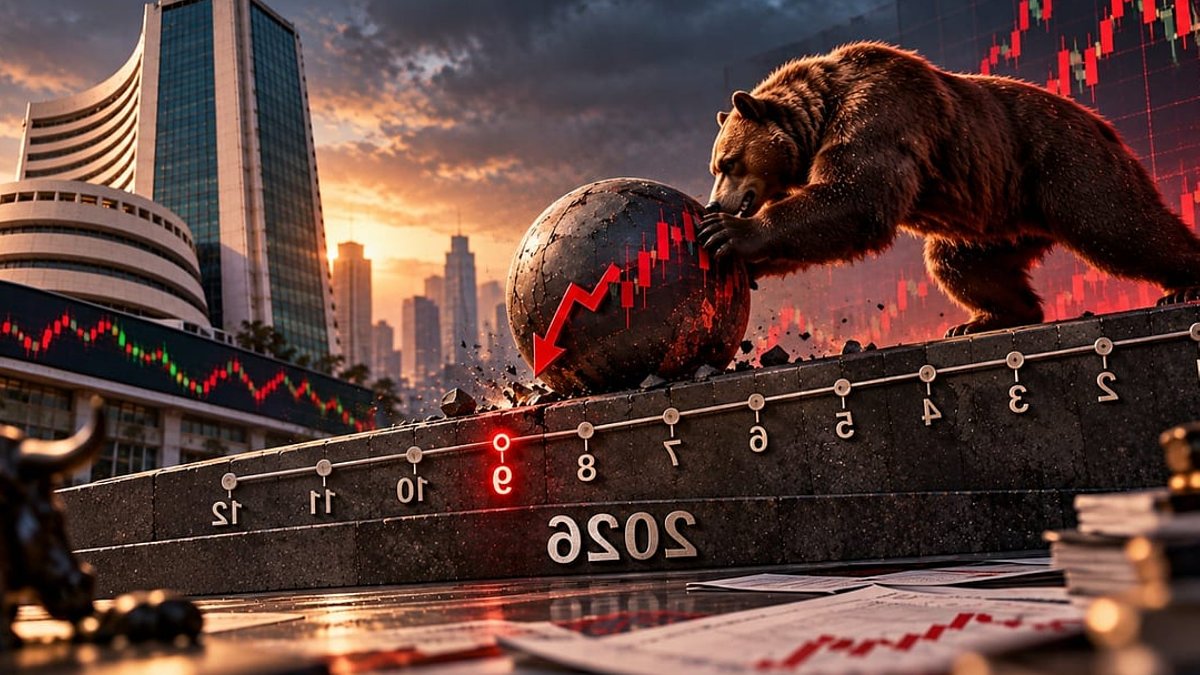
The Sensex and Nifty are on track for their worst nine-month performance in 15 years, with the two benchmarks down around 15% and 13% respectively since the start of calendar year 2026. The decline marks a sharp reversal from expectations at the beginning of the year, when domestic economic resilience and strong corporate earnings had initially supported investor sentiment.
This sell-off is not driven by a domestic economic crisis but by a combination of external pressures that have disproportionately targeted India’s large-cap stocks. Foreign portfolio investors (FPIs) have pulled out approximately ₹2.50 lakh crore ($26.75 billion) from Indian equities in the first nine months of 2026, according to NSDL data, while domestic institutional investors (DIIs) have pumped in ₹6.28 lakh crore. The domestic buying has acted as a cushion, but it has not been enough to offset the broader market weakness.
Rising Oil, Yields and a Weakening Rupee
Higher crude oil prices, rising US bond yields, geopolitical tensions, and a weakening rupee have made emerging-market equities less attractive to foreign investors. Brent crude has touched $106, while the US 10-year Treasury yield has hovered around 5.2%, increasing pressure on inflation expectations, corporate margins, and capital flows.
The impact has been most severe on India’s largest companies. Reliance Industries, HDFC Bank, and Bharti Airtel—three of the country’s most valuable firms—have each fallen between 16% and 27% over the same period. Tech giants like TCS and Infosys, along with consumer staples firms such as Hindustan Unilever and ITC, have also declined by 19% to 37%. These losses have had an outsized effect on the Sensex and Nifty, given their heavy weighting in the indices.
IT and FMCG Sectors Take Biggest Hits
Sectoral performance reinforces the trend. The Nifty IT index has plunged 27%, making it the worst-performing sector this year. Meanwhile, the Nifty FMCG index has fallen 19%, while energy and financial stocks have declined by 13.6% and 10.7% respectively.
Foreign institutional investors have played a central role in the downturn. Over the last four trading days alone, they sold ₹24,054 crore worth of equities, according to V K Vijayakumar, Chief Investment Strategist at Geojit Investments. The selling has been described as rational in the context of US bond yields remaining near that level, a situation that has reduced the appeal of emerging-market assets.
The pressure intensified sharply in September. Foreign investors became more defensive in the derivatives market, with FII index shorts rising 41.9% to 2.95 lakh contracts from 2.08 lakh in August, while index longs increased by only 16.9% to 27,879 contracts. This positioning widened FIIs’ net index short position to 2.67 lakh contracts, the highest since the start of the September series.
The bearish sentiment extended beyond derivatives. Nifty lost more than 1,400 points during the September series, its sharpest monthly decline in a quarter-century. The index has now ended seven consecutive weeks in the red, with the potential for an eighth straight weekly drop if no recovery materializes. Such a streak would be the longest since 2001.
Mid-and Small-Cap Stocks Defy Downturn
Despite the broad market weakness, mid- and small-cap stocks have held up relatively well. The Nifty Smallcap 100 has gained around 8-9%, while the Nifty Midcap 100 has declined by only 1-2%. This divergence reflects stronger domestic liquidity, including SIP flows exceeding ₹30,000 crore per month, as well as lower foreign investor participation in these segments.
The broader market’s resilience is also linked to its exposure to domestic themes. Unlike large-cap indices, which are heavily weighted toward traditional sectors like banking, IT, and energy, mid- and small-cap indices include more representation from capital goods, power, defense, and manufacturing. These industries continue to benefit from government infrastructure spending and local economic expansion.

Kotak Mahindra Bank Appoints Anup Saha as MD & CEO


